Use a private urge log to reflect on a chosen habit
Most “quit porn” tools focus on blocking websites. That can help, but it doesn’t tell you why you keep going back — or what’s actually improving over time.
A blocker and a journal serve different purposes. One limits access; the other can preserve the situation, feeling or choice you want to revisit. Neither is a guaranteed solution, and choosing to change a habit does not mean every urge needs to be treated as a disorder.
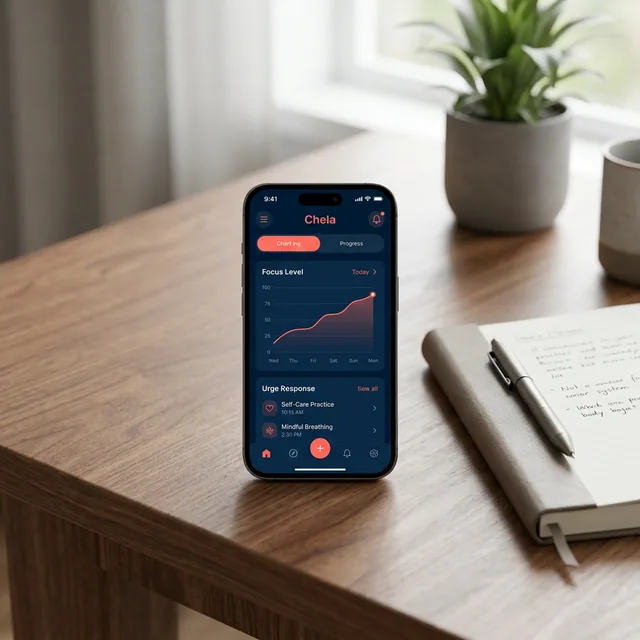
Chela includes Quit It for tracking habits you want to change. You can keep that record alongside voice reflections and use the app’s visual history to revisit what you recorded about a habit you choose to change. The App Store release notes describe Quit It and the improvements to its tracking history. Those features help organise your record; they do not diagnose a condition or establish a treatment outcome.
What an urge journal can add to a day counter
If you’ve tried NoFap before, you’ve probably seen the classic cycle:
- An initial goal can be easy to remember.
- A difficult day may make a rigid counter feel discouraging.
- A record with context gives you something more specific to reflect on.
One useful question is whether your record contains enough context to help you understand the situation later:
- When do urges spike? (night, stress, loneliness, boredom?)
- What apps or sites usually start the spiral?
- What did you do differently on the days you actually won?
A short voice note can preserve the context without requiring a long entry. You can also record a minimal manual metric if that suits you better. Choose the amount of detail deliberately, especially for sensitive material.
How to keep an urge journal in Chela
Start with a simple note about the goal you have chosen for yourself. When something relevant happens, describe it in your own words:
- Open Chela and hold the record button.
- Say: “Log: strong urge to watch porn after scrolling social media in bed.”
- Or: “Relapse: watched porn for 30 minutes after a stressful meeting.”
Review the note for details you actually supplied:
- The situation and feeling you described.
- A circumstance you think may be relevant, clearly marked as your interpretation.
- What you chose to do and whether there is an outcome to record.
After collecting dated entries, you could ask questions such as:
- What situations did I describe this week?
- Are there repeated times or circumstances in the entries?
- What is missing from the record?
Setting up your own reflection routine
Step 1 – Define your goal in your own words
Define the change in language that fits your circumstances. You do not need to adopt a community label or someone else’s rules. A first entry might be:
“I want to spend less time on adult sites at night because I would rather use that time for sleep. I want to understand what tends to precede it.”
Keep that intention in a note you can revisit. When you review later entries, compare them with your chosen goal rather than treating every event as an automatic verdict from the app.
Step 2 – Log urges in real time (even if you slip)
The most important habit is not “never relapsing”. It’s “logging the truth quickly.”
- “Urge: scrolling TikTok in bed at 11:30pm.”
- “Victory: closed the app, went for a walk instead.”
- “Relapse: watched porn for an hour after a fight.”
Chela can help you keep and revisit the notes you record. It does not need a detailed account of every event to be useful. A missed entry is simply missing information, and this guide does not promise automatic streak calculations.
Step 3 – Review your patterns without judging yourself
After a few weeks, look for specific questions in the entries you have, rather than assuming that a pattern has already been established:
- Which entries mention late-night phone use?
- Did I describe stress, boredom or another circumstance?
- What changes did I try, and what did I actually observe afterwards?
A repeated detail may suggest an experiment you want to try, such as changing where you leave your phone at bedtime. It does not prove why an urge happened or predict which change will work. Keep the interpretation tentative and personal.
Using a journal alongside other support
Depending on your preferences and circumstances, other support might include:
- Device or browser controls you choose to set.
- A qualified professional if the behaviour causes distress or impairment.
- A trusted person with whom you choose to discuss a limited summary.
The journal’s contribution is the context you choose to save. It cannot establish causation or replace an assessment if the behaviour is causing distress or disrupting your life.
Example: a month of optional habit reflection
- Record your own goal and what you want to understand.
- Choose a level of detail you are comfortable saving.
- Make a short note when it is useful, and check the processed wording.
- Review a week of entries, including gaps and uncertain interpretations.
- Choose whether to try a small change or seek more support.
Protecting your privacy while you rebuild your habits
These notes can contain sensitive information. Before recording, consider the device you use, who can access it and whether you need to include identifying detail. Read Chela’s privacy policy to understand processing and data handling.
- Decide whether you need identifying or explicit detail at all.
- Protect access to the device and account you use.
- Inspect any export or summary before sharing it.
Review what you have saved and use the deletion and sharing options available in the app. If you share a summary, read it first and choose the recipient deliberately. Keeping less detail may be the right choice for you.
Related habit-reflection guides
If you’re working on multiple addictions or habits, these may help:
Make the journal useful for your own goal
A log can be brief: the situation, what you chose and anything you want to try next. You do not need a public streak or a perfect record. Leave room for uncertainty rather than asking the app to explain every part of your behaviour.
Chela can keep these reflections with the other notes you choose to save. Voice capture is available on paid plans, while manual task creation and metric tracking are free.
A first line might be: “This is the habit I want to understand, and this is one small change I want to try.” Review the note when it is useful, rather than making the log another obligation.
Free accounts include manual task creation and metric tracking. Voice notes require a paid plan. See the app for current subscription limits and regional prices.