Voice calorie tracking: log a meal and check the estimate
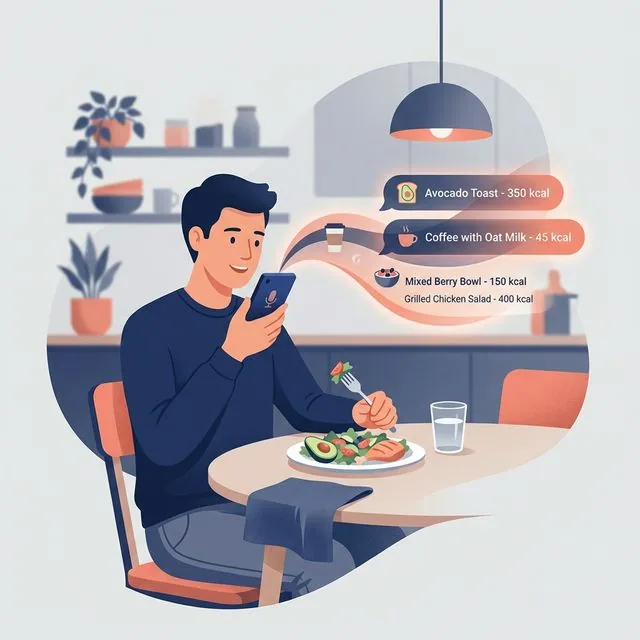
Most people who try to track what they eat give up within two weeks. It is not because they stop caring about their health — it is because the logging feels like a second job. Searching for "homemade chicken stir-fry" in a database, adjusting serving sizes by grams, adding each ingredient one by one — all of that happens right after you finish eating, when you least want to do admin work.
A voice calories tracker flips that friction completely. Instead of typing, you speak. Instead of searching, you describe. The log happens in the moment, the way you would tell a friend what you just ate.
What a voice calories tracker actually does
A voice calories tracker is an app or feature that lets you record what you ate by speaking naturally, then organizes that information into structured food entries — including estimated calories, macros, or other metrics you care about.
The key word is naturally. You do not say "chicken breast, 150 grams, grilled." You say "had a grilled chicken salad with olive oil dressing for lunch." The system figures out the rest.
This is different from calorie apps that bolt on a voice search as a shortcut for their database. Those still require you to confirm a specific food entry with a specific weight. A real voice-first food tracker accepts your description as input and works forward from there — treating your words as the source of truth, not as a search query.
Why traditional calorie apps lose people so quickly
The drop-off is not a motivation problem. The data is clear: most people stop logging within two weeks of starting, and the main reason cited is that it takes too long.
Think about what typical calorie tracking actually requires:
- Open the app right after eating, before you forget
- Search for the food — often with multiple results to choose from
- Select the right portion size and unit (oz, grams, cups, slices)
- Repeat for every component of the meal
- Do this three to five times a day, every day
That works for people who are deeply committed and have routine, predictable meals. For everyone else — people with irregular schedules, mixed dishes, meals out, or just busy days — it breaks down fast.
The data you get when you do stick with it is useful. The problem is the cost to collect it.
Who benefits most from logging calories by voice
Voice-based food logging is not for one type of person. It works well across different situations where the act of stopping to type creates a real problem.
Busy parents and caregivers
If you are managing meals for a family, your own eating often happens on the move — a few bites while cooking, a quick lunch between pickups, dinner over conversation. There is never a clean moment to sit down and log. Speaking a quick note as you eat — or right after — fits the actual rhythm of those days.
People who are new to tracking
Calorie awareness is a skill. If you have never tracked before, starting with a rigid database app can feel overwhelming. Voice logging lowers the bar. You do not need to know exact weights or serving sizes to start building useful habits. You just describe what you ate, and the system handles the estimation.
Anyone with ADHD, dyslexia, or fine motor challenges
Text-heavy interfaces with lots of small inputs are genuinely difficult for some people — not for lack of effort, but because typing and precise selection are cognitively or physically demanding. Voice input removes that barrier without requiring any workaround.
Commuters and people on the go
Eating a snack between appointments or grabbing a coffee between calls can be easy to forget later. When you have a safe moment and a comfortable place to speak, a short meal note preserves the details. Manual entry may be more suitable in a quiet shared room. The useful routine is one you can keep and review.
People tracking alongside other health metrics
If you are also logging water by voice, tracking sleep, or noting how you feel after meals, having everything in one spoken log means your food data connects naturally to the rest of your health picture. It is not a separate app with a separate habit — it is part of one continuous record.
Common real-world use cases
The situations where voice food logging actually gets used are different from the situations where people plan to use it. Here is where it shows up consistently:
Post-workout, hands still sweaty: Instead of unlocking the phone and navigating an app, a quick spoken note captures the protein shake and banana before you even leave the gym.
Eating out: You had pasta at a restaurant and have no idea of the exact ingredients. You say what you remember. The log exists. It is imperfect and that is fine — a rough log is better than no log.
Cooking and tasting: You add things to a dish as you go. A voice note as you cook captures those additions without interrupting the process.
Late-night snacking: The meals most people forget to log are the unplanned ones. A twelve-second voice note at 11 PM is far more likely to happen than opening a tracking app.
What a voice food log captures that typing cannot
When you speak about what you ate, you naturally include context that a typed log entry strips out. You might say "had a big lunch, the portion was way larger than usual" or "not very hungry so only finished half." That kind of context — hunger level, portion sense, how the meal felt — is lost the moment you reduce eating to a food name plus a gram weight.
Over time, that context is often more useful than the calorie number. Knowing that you consistently overeat on days when you skipped breakfast, or that you feel sluggish after certain meals, is the kind of pattern that actually changes behavior. Typed entries rarely hold that information.
What to look for in a voice calories tracker
Not all voice food logging tools work the same way. Here is what separates the ones that stick from the ones that get deleted:
- Accepts natural descriptions: You should be able to say "lamb kebabs with hummus and a beer" without needing to reformulate it as a database query.
- Does not require confirmation for every entry: If every voice note triggers a review screen with a list of matching foods to approve, you have not solved the friction problem.
- Works across the day, not just for meals: Snacks, drinks, and small bites matter. The app should make those just as easy to log as a full meal.
- Connects food to the rest of your health data: A food log that lives in isolation is useful. A food log that connects to your energy, sleep, workouts, and mood is genuinely insightful. Look for a voice health tracker that treats nutrition as one input among many.
- Makes retrieval easy: The point of logging is not the log — it is what you learn from it. You should be able to ask "what did I eat last Tuesday?" or "what do I usually eat before a bad sleep night?" and get an answer.
How voice tracking compares to typing in a calorie app
|
Situation |
Typing into a calorie app |
Voice calories tracker |
|---|---|---|
|
Eating on the go |
Requires stopping, unlocking, navigating |
A short spoken note when safe and convenient |
|
Mixed or homemade dishes |
Must log each ingredient separately |
Describe the dish as you would to anyone |
|
Eating out at a restaurant |
Search for the closest match, adjust portions |
Describe what arrived on the plate |
|
Snacks and small bites |
Often skipped because it feels tedious |
Quick note in passing, no friction |
|
Adding context (hunger, mood) |
Separate field, often ignored |
Part of the natural description |
|
Accuracy over time |
Depends on food matching and portion review |
Depends on the details supplied and the review |
Neither approach is universally better. But for most people, a consistent imprecise log beats a precise log they abandon after twelve days.
The difference between voice search and voice logging
Some calorie apps offer voice search for a food database; others accept a natural-language meal description. The distinction is worth checking in the current product. MyFitnessPal, for example, offers Premium Voice Logging. In either workflow, check the matched foods and portions before treating the result as a useful estimate.
A genuine voice calories tracker goes further. It accepts a spoken description of your meal, stores the full context, and builds the log from your words rather than from a database lookup. That distinction matters enormously for the situations where calorie logging actually breaks down: irregular meals, foods without barcodes, and moments when you have no patience for a multi-step process.
Where Chela fits into a voice-based health routine
Chela is built around the idea that your voice is the fastest way to capture anything — meals, moods, workouts, observations. When you speak a note after eating, Chela stores the raw audio, transcribes it, and structures the information so it is searchable and useful later.
That means your food logs live alongside your other voice health tracking data — sleep notes, energy levels, workout logs — in one place. You can track habits through voice without juggling multiple apps or maintaining separate logs for each metric.
For people who have tried calorie apps before and bounced off them, the difference is not features — it is input method. When logging feels like talking, the habit tends to stick. When it feels like data entry, it does not.
If you are comparing dedicated calorie apps, examine their food database, portion correction, nutrition detail and voice options. MyFitnessPal supports Premium Voice Logging on iOS and Android in English, so this is not simply voice versus typing. Our comparison explains the different routines and what to test in each.
A practical way to start today
You do not need a specialized voice calories tracker to get started. You need a way to speak a meal note right after eating and have it go somewhere you can retrieve it. Start with the simplest version of that habit: after each meal, spend ten seconds describing what you ate out loud.
Once that becomes automatic, you can layer in structure — looking back at your logs weekly, noting patterns, and adjusting. The goal is not a perfect nutrition database. It is a memory of what you actually ate, in a form you will actually create.
Most people know roughly what they should eat. What they lack is an honest, low-friction record of what they actually do eat. A voice calories tracker closes that gap not by making tracking smarter, but by making it easier to start — and easier to keep going.
Start Logging Meals in Seconds.
Chela turns your voice into a searchable food diary, habit log, and health record — all without typing a single thing.
Keep Reading
Voice Notes vs Dictation App: Which to Choose?
Voice notes save audio, dictation apps produce text. Knowing which to reach for changes how quickly ideas go from spoken to useful.
The Best Note-Taking System for People Who Hate Note-Taking
A better system starts with a simple promise: you should not have to become "a note person" to get the benefits of notes.
Free accounts include manual task creation and metric tracking. Voice notes require a paid plan. See the app for current subscription limits and regional prices.